




















Sage 100 Integration FAQ
Sage 100 Integration FAQ
When connecting Sage 100 to external systems, businesses typically choose between generic middleware platforms, basic flat-file tools, or custom API development. However, IN-SYNCH stands out as the superior choice because it is a native, Sage-installed application specifically engineered around Sage 100’s unique data structures rather than a “one-size-fits-all” solution. Unlike generic connectors that rely on delayed batch syncs, IN-SYNCH delivers true real-time, bidirectional synchronization while allowing both systems to run independently if one goes offline. It also offers unmatched security by initiating data transfers securely from inside your firewall, eliminating the dangerous need to open incoming server ports. Furthermore, IN-SYNCH avoids the costly, unpredictable transaction-based fees charged by middleware competitors, providing a scalable solution backed by decades of proven Sage expertise.
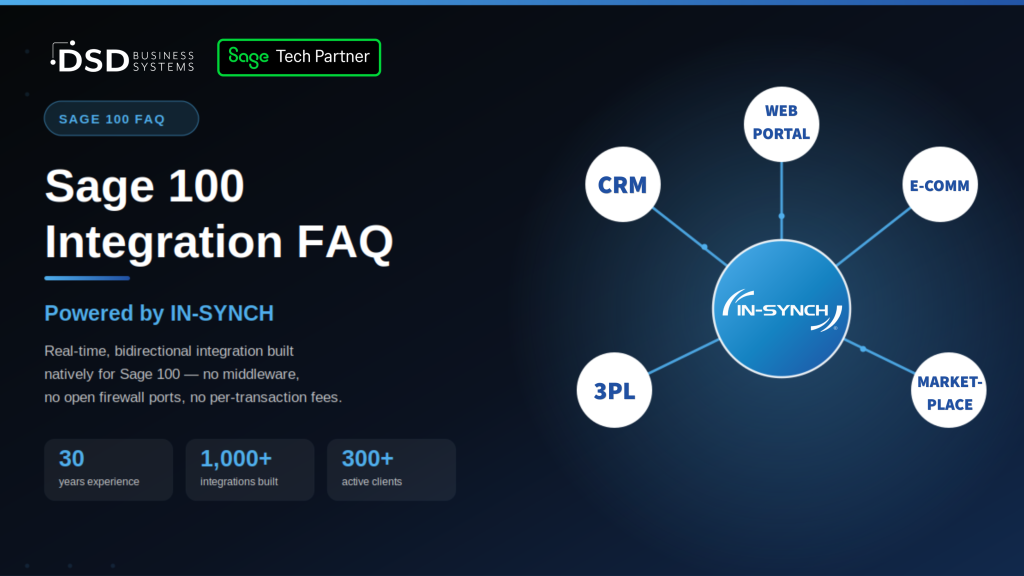
IN-SYNCH connects Sage 100 to virtually any third-party business application, web solution, or cloud platform. It offers proven, turnkey integrations with major e-commerce platforms like Shopify, BigCommerce, Adobe Commerce, and WooCommerce. It also seamlessly links Sage 100 to popular CRM platforms like Salesforce, HubSpot, and Zoho, as well as digital marketplaces like Amazon, Walmart, and eBay. Beyond sales channels, IN-SYNCH integrates third-party logistics providers, warehouse management systems, databases, and custom web portals. Thanks to flexible options like our Connector API, we can even build robust connections to proprietary or custom-built internal applications. IN-SYNCH truly can do it all!
The cost of our projects depend on what you want to integrate. Typical projects start at $10K and go up from there according to the scope of the work. Most of the initial project costs are one-time fees with some small annual fees. We do not charge per transaction or by transaction volume.
The length of the project depends on how many touch points we integrate. A typical project is 2 weeks of onboarding followed by 4-6 weeks of work. After we complete multiple projects for your company, an integration project may take as few as seven to ten days.
Through IN-SYNCH, we offer pre-built and customizable integration pipelines for CRM platforms like Salesforce, HubSpot, and Zoho. The integration can automatically sync customer profiles, contact info, sales orders, invoice histories, and customer-specific pricing structures between systems. Alternatively, if you utilize a custom or lesser-known CRM, our Connector API allows your developer to build customized data flows tailored to your company.
IN-SYNCH can integrate almost any standard or custom data table available within the Sage 100 ecosystem. Common data points include core Master Files such as customer records, vendor details, product catalogs, and item quantities. IN-SYNCH also seamlessly syncs transactional data, including sales orders, invoices, payment receipts, tracking numbers, and fulfillment updates. IN-SYNCH can even handle advanced integrations like complex price levels, tier tables, customer-specific pricing, and user-defined fields so your unique business logic carries over seamlessly. It just needs a place to be stored in the third party system.
The most frequent implementation projects we encounter connect Sage 100 to B2B and B2C e-commerce stores on platforms like BigCommerce and Shopify or online marketplaces such as Amazon, Walmart, and eBay. We also routinely implement CRM integrations with Salesforce or HubSpot. Shipping and 3PL integrations are also widely popular for businesses looking to automate label creation, tracking updates, and warehouse stock levels. Finally, multi-entity organizations frequently use IN-SYNCH to automate intercompany transactions.
While custom API development might seem flexible initially, it often leads to high long-term maintenance costs and technical debt whenever Sage 100 or external platforms update. IN-SYNCH provides a proven, battle-tested architecture that insulates you from breaking changes when underlying software upgrades occur. Custom-coded solutions require dedicated developers to monitor error logs, patch security vulnerabilities, and rewrite scripts as your business scales. In contrast, IN-SYNCH is backed by decades of active support and engineering expertise dedicated specifically to maintaining Sage 100 compatibility. If you’re looking for a custom Sage 100 API, check out our Connector API for custom development options powered by IN-SYNCH.
A: Sage 100 does not have an API built into the system. Therefore, to create unique Sage 100 integrations, a third-party API like IN-SYNCH Connector API is necessary.
IN-SYNCH does not change/modify any functionality in Sage 100, so reporting should continue to work as before. Standardized data mapping is critical during initial setup. Keeping your data clean prior to integration prevents duplicate records and skewed totals from polluting your executive dashboards and sales reports.
Yes, IN-SYNCH is designed to connect Sage 100 to multiple external applications simultaneously without compromising speed or system performance. Each connection operates independently, meaning maintenance on one endpoint (like updating your website) won’t disrupt the flow of data to your CRM or 3PL.
With IN-SYNCH, data in your Sage 100 ERP and your integrated systems is real-time and continually synchronized. The speed of synchronization is only limited by the third party platform’s restrictions.
Unlike generic cloud middleware that charges unpredictable transaction or volume fees, IN-SYNCH offers transparent pricing with no per-transaction charges. Its unique architecture initiates data transfers from inside your Sage 100 server, providing maximum security without requiring open firewall ports. IN-SYNCH offers true real-time, bidirectional mirroring rather than scheduled batch syncs, ensuring your systems are constantly updated. Additionally, both systems operate independently; if your web server temporarily goes down, Sage 100 keeps running and automatically syncs all queued changes once reconnected. Backed by nearly 30 years of Sage-specific experience and over 1,000 active implementations, IN-SYNCH provides unmatched reliability.
With our team’s almost 30 years of experience with IN-SYNCH and third-party APIs, the answer is almost always “yes, we’ve done this before!” And yes, we can integrate your unique system. IN-SYNCH fully supports custom fields, user-defined fields, and custom tables created within Sage 100. Our engineering team configures these mappings during onboarding so your specific business logic is completely preserved. In addition, IN-SYNCH easily accommodates complex B2B commerce rules by directly accessing and translating Sage 100 pricing logic. It can sync customer-specific price sheets, quantity break tiers, contract pricing, promotional rules, and custom credit limits in real time.
The primary reason integration projects fail is dirty data. Before integrating anything, a company’s data needs to be clean—dirty data stays dirty. Automating dirty data won’t help! The more engaged the clients’ project leaders, the more smoothly the project will go. The most successful integration projects happen when our IN-SYNCH team is paired with engaged, responsive subject matter experts from our clients’ companies.
We have completed more than one thousand integration projects. 300 active clients are on our active IN-SYNCH maintenance plan—and most come back for multiple projects to expand their software integration abilities. IN-SYNCH has been around for nearly 30 years, proving its stability and flexibility.
If your website, CRM, or Sage 100 server experiences an outage or temporary loss of internet connectivity, IN-SYNCH automatically buffers all pending data. The system continuously attempts to reconnect in the background while safely holding inbound and outbound transactions in a secure queue. Once the connection is fully restored, IN-SYNCH resumes synchronization without missing a beat or duplicating records. This fault-tolerant architecture ensures that dropped connections never result in lost orders, missing customer data, or corrupted inventory balances.
IN-SYNCH is designed with top-tier security standards to protect your sensitive data. Unlike traditional integration tools that expose your network to external threats, IN-SYNCH initiates all communications securely from within your local Sage 100 server. This outgoing-only communication model means you never have to open incoming firewall ports or expose your accounting system to the public internet. All data transferred between platforms is fully encrypted in transit using industry-standard protocols.
IN-SYNCH is engineered as a modular solution that grows and adapts alongside your changing business technology. When you upgrade to a newer version of Sage 100, IN-SYNCH is updated alongside it to maintain seamless operational continuity. If you decide to migrate your e-commerce site from one platform to another, your underlying Sage 100 integration architecture remains intact. Only the web-facing endpoint needs to be reconfigured, saving you substantial time and investment compared to rebuilding an integration from scratch.