




















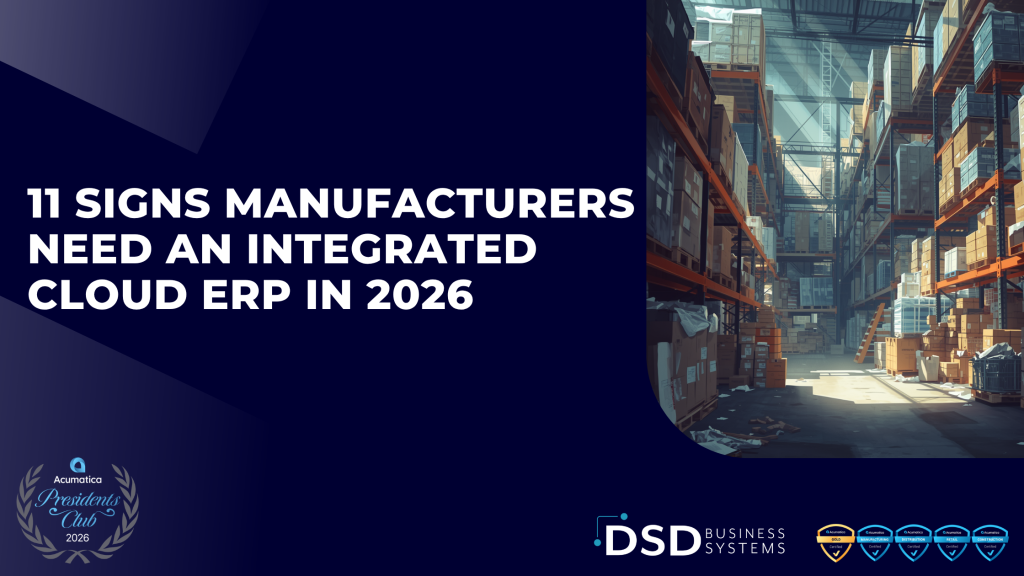
11 Signs Manufacturers Need an Integrated Cloud ERP in 2026
Growing a manufacturing business is exciting, until your software starts holding you back. If you’re running production on basic accounting and inventory tools, you may be hitting walls you didn’t see coming.
DSD Business Systems helps manufacturers identify when it’s time to move beyond entry-level software and adopt an integrated cloud ERP built for growth. This guide walks through 11 warning signs that signal your current tools can no longer keep pace. From inventory inaccuracies to multi-entity complexity.
The 11 Warning Signs for Manufacturing ERP Evaluation
1) Spreadsheet dependency: You’re maintaining inventory counts, production schedules, or job costs in spreadsheets because your software can’t handle the complexity needed.
2) Inventory discrepancies: Physical counts regularly differ from system records, leading to stockouts or excess inventory.
3) Manual data entry: Your team re-enters the same information across multiple systems, sales orders, production, shipping and accounting.
4) Delayed financial close: Month-end takes weeks because you’re reconciling data from disconnected siloed sources.
5) No real-time visibility: Answering “what’s our inventory status?” requires pulling reports, checking spreadsheets, and calling the warehouse.
6) Job costing gaps: You can’t accurately determine profitability by job, product, or customer without extensive manual analysis.
7) Multi-location complexity: Managing inventory and transactions across facilities requires duplicate data entry or error-prone transfers.
8) Production planning by memory: Scheduling relies on tribal knowledge rather than system-driven capacity planning.
9) Compliance concerns: Lot tracking, traceability, and audit trails require manual documentation outside your core system.
10) Growth constraints: Adding products, customers, or facilities means exponentially more manual work.
11) System performance issues: Your software slows down as transaction volumes increase.
When should manufacturers start evaluating additional integrated Cloud ERP options?
The right time to evaluate a new ERP is before your current tools create a crisis. Waiting until spreadsheets collapse or inventory errors cost you a major customer puts you in reactive mode. Manufacturers typically recognize they’ve outgrown basic accounting and inventory software when daily operations require workarounds that consume more time than the actual work. According to industry research from GITNUX, inventory accuracy improves by 25% after ERP implementation, highlighting how much visibility basic tools leave on the table.
Start your evaluation when you notice any of these patterns:
Your finance team spends more time gathering your data than analyzing it.
Operations staff have created personal systems (spreadsheets, notebooks, whiteboards) to track software shortcomings.
You’ve delayed adding products or locations because your systems can’t handle the complexity.
Why Acumatica is The Solution for Manufacturers
Finding the right integrated Cloud ERP means looking beyond basic accounting features. You need software that understands production workflows, tracks costs at the job level, and gives you real-time visibility into shop floor operations.
Here’s what we evaluated:
- Production planning capabilities: Can you schedule production orders, manage work-in-progress, and track labor costs without building spreadsheet workarounds?
- Inventory accuracy: Does the system support lot tracking, multiple locations, and real-time stock visibility across your entire operation?
- Financial integration: Can you see job costs, margins, and variance reports without exporting data to external tools?
- Multi-entity support: If you run multiple locations or companies, can transactions flow automatically without manual reconciliation?
- Shop floor connectivity: Does the system connect to your production environment for backflushing, labor tracking, and material consumption?
- Scalability: Will this system handle increased transaction volumes, new product lines, and additional facilities as you grow?

Why DSD is a standout Gold Certified Acumatica Cloud partner for manufacturers
DSD stands out because we combine software expertise with manufacturing industry knowledge. As a 2025 and 2026 Acumatica President’s Club winner with over 40 years in the software business, DSD brings credibility that generic software partners can’t match. Our team evaluates your production workflows, identifies system requirements, and recommends solutions that address your actual challenges, not generic feature lists. This people-first approach means you work with consultants who understand manufacturing operations, not just software configuration.
For manufacturers ready to move beyond basic accounting and inventory software, DSD delivers the integrated Cloud ERP expertise and solutions to support your growth. Request a demo to see how Acumatica Manufacturing can address the warning signs holding your operation back.
FAQs about using a manufacturing ERP for growing businesses
Basic accounting software tracks financial transactions, invoices, payments, and general ledger entries. Manufacturing integrated Cloud ERP connects those financials to production operations, including bills of materials, work orders, shop floor tracking, and job costing.
We help you understand which capabilities your operation actually needs, so you’re not paying for features you won’t use.
Some manufacturers phase their transition, running basic accounting in QuickBooks while adopting production-specific modules. However, this approach creates integration challenges and data silos that often negate the benefits of an ERP.
We recommend evaluating whether a full transition to integrated Cloud ERP delivers better long-term value than maintaining multiple systems.
Training requirements depend on each role’s interaction with the system. Shop floor staff may need a few hours on production reporting, while finance teams require deeper training on costing and reporting modules.
We include role-based training in their implementation methodology, ensuring each team member learns the specific functions they’ll use daily.
Final Thoughts: How does DSD Business Systems support manufacturers after go-live?
DSD offers ongoing support services for all their software solutions. Our support team handles technical issues, while consultants remain available for process optimization and additional training as your team’s needs evolve over time.
This national presence and people-first approach ensures you have access to expertise whenever questions arise, not just during implementation.